

Political Content on News Sites: Status Quo Proves Hard to Change
12 март 2012, Автор: Nikoleta Daskalova
Публикувана в 2011 Media Monitoring Report
This monitoring study of Bulgarian online news resources included websites of print and broadcast media, news agencies, and news sites with a national and regional focus. It used data gathered via online tools such as the Europe Media Monitor (ЕММ) and Google News. The analysis focused on domestic political news, examining the changes in the coverage of key political actors as well as the main topics on the media agenda.
Political Actors
The data on the coverage of political actors on Bulgarian news sites show a trend that is certainly not new. It consists in the dominant media presence of Prime Minister Boyko Borisov, followed by deputy prime ministers Tsvetan Tsvetanov (Interior Minister) and Simeon Djankov (Finance Minister). Tsvetanov and Djankov have been among the top actors in the news since this government came to power, while excessive coverage of Borisov is a norm followed by the Bulgarian media even before he became prime minister. This norm grew into an informal media rule after Borisov’s GERB party won the elections in July 2009. What is new, however, is the slight decline in news coverage of the prime minister in 2011. Whereas in 2010 Borisov was among the most popular people in the news on 350 out of the 365 days of the year, in 2011 his popularity dropped to ‘a mere’ 331 days (Figure 1). Even so, in 2011, too, Borisov far outstripped all other politicians (by a factor of 2.3) by total number of mentions (Figure 2).
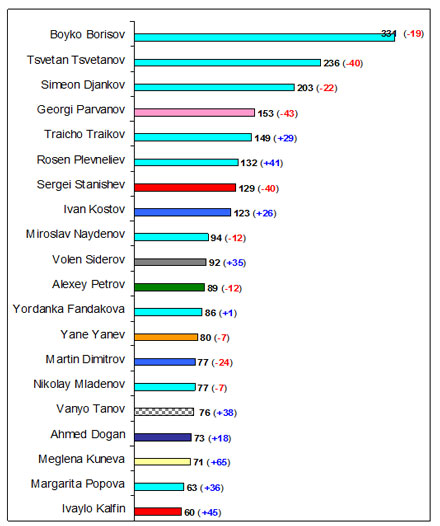
Figure 1. Politicians most often mentioned on news sites in 2011, by number of days. The figures in brackets show the difference (in number of days) as compared to 2010.
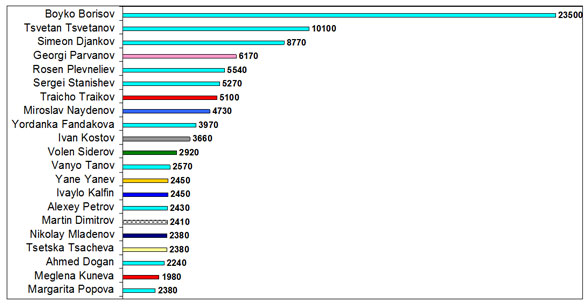
Figure 2. Politicians most often mentioned on news sites in 2011, by total number of items.
Another peculiarity in the context of Bulgarian online media was the declining coverage of two of the most significant institutional representatives: the outgoing president, Georgi Parvanov, and National Assembly Chairperson Tsetska Tsacheva. The decrease in Parvanov’s number of mentions reveals the poorly visible role which the president played in the year of presidential elections. For its part, Tsacheva’s ‘drop’ is an indication of the overall loss of media interest in the parliamentary institution.
Opposition leaders Sergei Stanishev (BSP), Yane Yanev (RZS) and Martin Dimitrov (SDS, Blue Coalition) were also less mentioned on news sites in 2011. By contrast, Ivan Kostov (DSB, Blue Coalition), Volen Siderov (Ataka) and Ahmed Dogan (DPS) were mentioned more often than in 2010. In the case of Kostov this was due to the fact that he was engaged in active opposition to the government, although this proved ineffective with a view to his party’s and coalition’s performance in both the presidential and local elections. The reason for the increase in the number of mentions of Siderov and Dogan was different. It was the result simultaneously of in-party tensions, scandals surrounding their names, and their campaign appearances, which were throughout the year in the case of Siderov, who was running for president, and ad hoc in the case of Dogan, whose rhetorical trick that he would support the BSP candidates for president and vice president in exchange for ‘a nice kiss’ was turned by the media and politicians into the main event in an otherwise uneventful campaign.
Main Topics
The monitoring study of the domestic political content on Bulgarian news sites shows that in 2011 online media focused on three main topics: the scandalous uses of special surveillance devices (SRD), Bulgaria’s big energy projects, and the presidential and local government elections. The presence of those three topics in the news varied over the year.
The leaked wiretapped conversations between Prime Minister Borisov and National Customs Agency Director Vanyo Tanov incriminated both in unlawful protection of a businessman known as Misho Birata (The Beer). The scandal blew up at the beginning of 2011. The media reaction was universal – simultaneously in the traditional media (see, for example, the articles in this report by Elena Koleva on the Bulgarian press and by Georgi Savchev on Bulgarian radio) and in the social media (see Julia Rone’s analysis in this report). The topic was given extremely high news value in the first two months of the year, which was enough to turn Tanov into one of the most popular people in the news in 2011 (figures 1 and 2) – an until then unimaginable position for a director of customs. Thus, the media once again proved the power of scandal in rearranging the priorities in the news. The effects of the scandal, however, were limited only to making it the top story in the news for weeks, without leading to real political changes.
The second main topic, Bulgaria’s key energy projects, did not follow a pattern of culmination, excessive coverage, and gradual disappearance from the news; it attracted consistent, long-term media interest with several high points. The topic itself emerged in the previous years and it was not new for 2011. What is interesting in the context of media analysis is that energy issues were (and are) discussed extensively mainly on the internet. This is indicated not only by the very intensive presence of the energy minister on news sites (something which was not typical of the other media outlets) but also by the finding that energy projects were among the most frequently discussed topics in the blogosphere (see Marina Kirova’s analysis in this report). The reasons are largely due to the fact that energy is not only a domestic political but also a geopolitical issue, which corresponds perfectly to the easy online access to foreign news resources. Bulgarian news sites are strongly oriented towards international topics and towards borrowing news from foreign media. At the same time, in 2011 Bulgaria’s energy administration also produced local scandals which additionally increased the news value of the topic (for example, the conflict in April between the prime minister, the energy minister and the finance minister over who had authorized the director of the National Electric Company to sign an agreement on the Belene Nuclear Power Plant project that binds Bulgaria to the Russian company Atomstroyexport).
The third main topic in 2011, the presidential and local government elections, followed a trajectory of steady increase in news items, with online media demonstrating readiness to cover the topic even at the beginning of the year. In the course of the campaign, however, media interest in the elections was reduced to pure reporting of the actions of the candidates and to an interest above all in the procedural and competitive elements of the campaign. The mechanisms of media coverage privileged the presidential campaign. The local elections were pushed to the background despite the higher practical significance of regional government (compared to the mostly representative functions of the presidential institution). In both elections, the media favoured the parties of the status quo: the ruling GERB party and the main opposition party, the BSP. This contributed to the public legitimation of the two parties as mutually alternative and it greatly impeded the media and electoral breakthrough of other political actors. As a whole, the dominant media climate created prerequisites for voting by inertia in line with the already accumulated attitudes towards the present government and especially towards the prime minister, rather than for forming new attitudes.
2011 in the News: More Minuses Than Pluses
The analysis of political content on Bulgarian news sites in 2011 points to several symptomatic developments which outline a picture that is far from rosy.
In the first place, Bulgarian news sites are continuing to represent a favourable environment for uncritical promotion of the Boyko Borisov media-political model. Expectations of a growing critical distance between the media and the prime minister are still far from reality. It is important to note that the problem is not in the media overexposure of the prime minister – he is undoubtedly the most important political figure in Bulgaria, and as such he deserves attention. The alarming symptoms are in that Borisov is surrounded by a mostly positive media climate where the media simply report his actions. As well as in the fact that all other political actors are drastically pushed to the background. This is what makes Borisov’s media coverage different from that of his predecessors in the last few years.
Another important trend in media developments in 2011 is the insatiable taste for scandal. Of course, this is not worrying in itself. On the contrary, scandal is a precious tool for stimulating democracy. What is noteworthy, though, is that in 2011 the key media scandals proved to be totally ineffective. The Borisov-Tanov-Birata affair, the government’s gaffe in signing an agreement on the Belene Nuclear Power Plant with Russia’s Atomstroyexport, the allegations that Rosen Plevneliev was involved in a municipal corruption scheme in 2007 because he had refused to pay a bribe demanded of him by municipal officials but had not reported them to the authorities – all of those scandals faded into oblivion, leaving the reputations of the protagonists in them untarnished. Here the media must be held responsible for the fact that they well-nigh enjoyed the scandals as an unquestionable sensation without offering a much-needed dose of analysis. All this is conducive to cultivating a dangerous public indifference and will inure the Bulgarian public to scandal.
The third negative trend is the lack of an analytical approach. In 2011, too, quality journalistic resources remained undeveloped. The efforts at introducing more serious and critical approaches to the news were most often limited to borrowing material from foreign media, to publishing WikiLeaks leaks and, what is very curious, to reprinting bloggers’ opinions. It turns out that citizens are a lifebelt for Bulgarian journalists who have given up on analysis and commentary.
Against this negative background, we should not ignore one positive development: an increasingly critical debate on the role of the media. The main factor for this development was the election campaign in which the relationship between the political status quo and media business caused a sharp wave of negative reactions from foreign organizations and politicians, secondary political actors, and individual journalists and citizens. The main criticisms were against the existence of paid publications and corrupt media, the lack of equal access to the media for the candidates in the campaign, and the media monopoly. Such critical reflection is no doubt an important step towards the normalization of the Bulgarian media environment. This is also the mission of this monitoring study.


